What if you could crash-land onto a totally new planet and explore it with billions of wild weapons at your disposal? That is the setup for Borderlands 4. Developed by Gearbox Software and published by 2K, it launched on September 12th, 2025 for PC, and 9th gen consoles, with a Nintendo Switch 2 release following on October 3rd, 2025. You play as one of four Vault Hunters, each with their own unique skills and playstyles, brought together to survive, loot, and take on a tyrant. It combines first-person shooter action with RPG mechanics, heavy looter-shooter staples, and a bit of fast-paced hack-and-slash combat as you play solo or co-op through an open world on the fictional planet of Kairos. But how do these new Vault Hunters, mechanics, and the world of Kairos actually hold up once you dive in? Let’s get into it.
Side Activities
When you’re not chasing down the main story, Borderlands 4 gives you a wide spread of side activities.
Side quests make up a large chunk of the optional content, with about 98 unique missions spread across the world. These aren’t just fetch or escort jobs, objectives vary enough to keep them from feeling repetitive, like faction quests. The rewards include the usual XP and loot, but you can also unlock cosmetics and occasionally stumble into Legendary drops. On top of that, each region has a quest board where you can pick up repeatable contracts. These are bounties or collection-style tasks that serve as optional grind content.
Borderlands 4 packs a variety of activities that tie exploration and looting together. Capture Silos are outposts you clear by fighting waves of enemies and planting signal beacons, unlocking fast travel and progressing Vault Key Fragments, while Safehouses act as checkpoints where powering up generators grants access to rest spots, vending machines, quest boards, and lore datapads. Scattered throughout the world, Ancient Crawlers are puzzle-like towers that open climbing platforms and hidden loot when activated. Loot-focused activities go further, from Vaults that require collecting Key Fragments to face themed bosses for high-tier rewards, to Abandoned Auger Mines and Order Bunkers offering dungeon-style runs with rare drops, and Ripper Drill Sites that challenge you with waves of enemies for loot crates. Finally, the Moxxi’s Machine allows repeated boss fights to farm Legendary gear.

Then we have world events, which are dynamic encounters that happen spontaneously as you explore Kairos. These can range from ambushes by enemy factions, to mini-boss skirmishes that pop up in the open world. Participating in these events rewards loot, experience, and sometimes rare items, giving you a reason to stay alert and explore every corner. They add a layer of unpredictability and excitement. If you want something more relaxing, there’s not much in the way of minigames, but the game does have fishing as part of the world events. It’s a lighter distraction where you reel in random loot and resources rather than just fish. It’s simple and optional, mostly serving as a breather between firefights.
Collectibles are fairly simple but do tie into progression. These include things like lost Vault Symbols, Lost Capsules, and Evocarium Puzzles scattered across the map. Finding them earns you SDU points, which can be spent on Storage Deck Upgrades for ammo, grenades, and other inventory boosts. It’s more of a background system than a major activity, but it gives exploration some extra incentive.
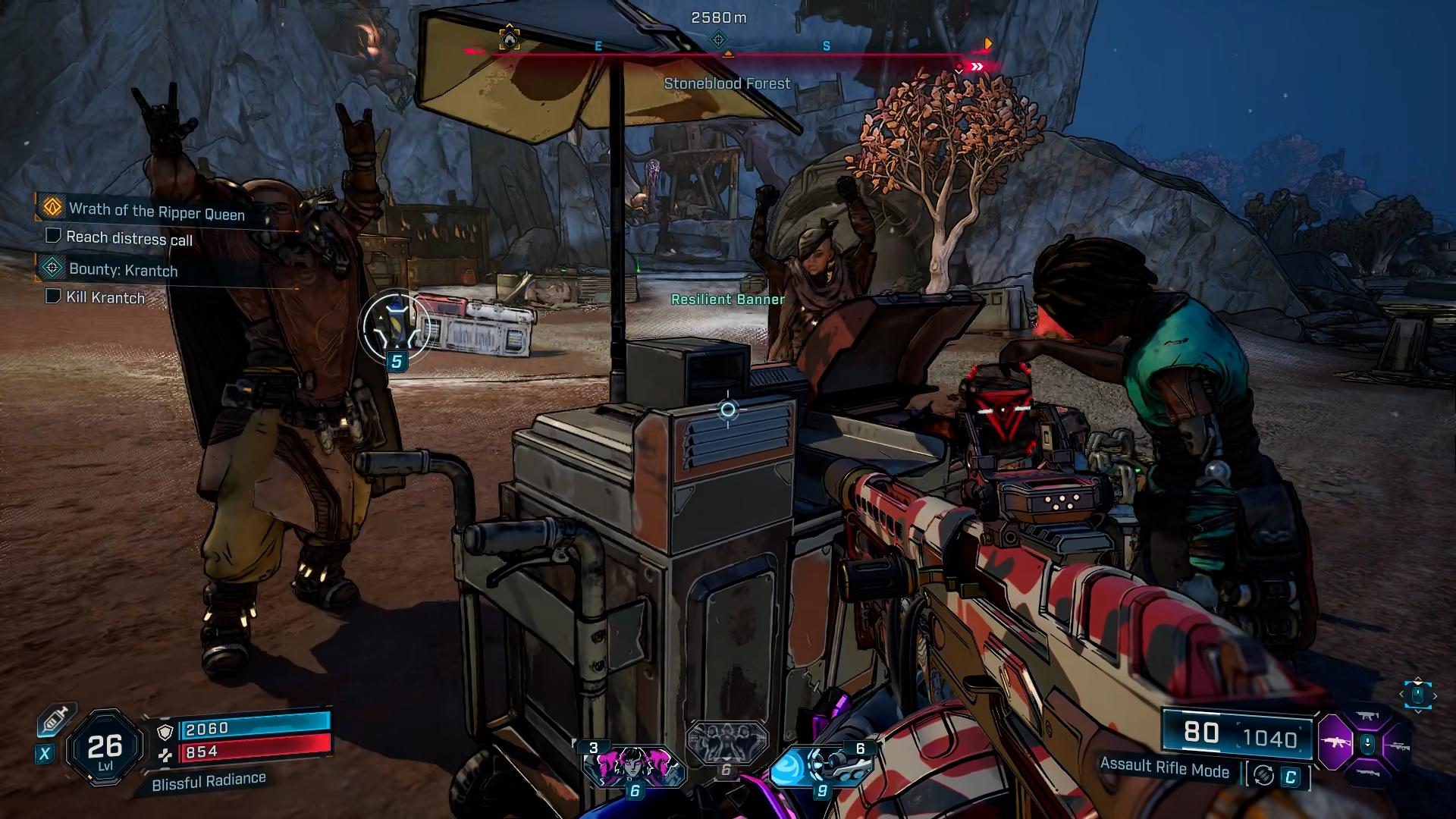
Shopping works as you’d expect in a Borderlands game. Vending machines and stores are scattered throughout towns and outposts, letting you buy and sell weapons, mods, and items. Each vending machine also stocks different items. So you gotta make sure to check regularly. The stock refreshes every 30 in-game minutes, and each machine highlights a rotating “Item of the Day.” It’s not a reinvented system, but it gives you reasons to check back regularly if you’re hunting for specific gear.

So with all that, you’ve probably guessed there’s a lot to do in Borderlands 4.
Area of Freedom
The world of Kairos is presented as one big unified map. While the in-game map marks out four separate regions, there aren’t any loading screens between them, so it's not segmented in practice. Each region is already pretty large on its own, and when you put all four together, the scale becomes clear. The only part gated by story progression is the middle section of the map. Otherwise, you’re free to move between regions either on foot or using a vehicle of your choice without any loading screens. If you’d rather skip the travel, you can fast travel through the map menu, though that does come with a loading screen, the same as when you enter dungeons. Some buildings can be entered as well, usually without needing to open a door since most are already left open. As for accessibility, the game uses soft invisible walls at the edges of the world. You’ll get a warning if you push too far, and eventually, it’ll kill your character if you ignore it. On the other hand, hills and taller structures often have harder invisible walls that stop you from climbing, though it fits logically with the terrain design.

All in all, Borderlands really stepped up the freedom to roam here, ultimately passing this aspect.
Liveliness
Kairos is split into four regions, each with its own look and atmosphere. You’ll move from tranquil fields to icy tundras, then into scorched wastelands to oppressive fortresses. Each area is distinct in its color palette and design, and the vibe of each region matches closely with its soundtrack and ambient sounds, whether that’s wildlife echoing through the landscape, harsh winds cutting across the tundra, or the hum of machines in the industrial hubs.
Settlements are scattered throughout the map, and their liveliness mostly depends on their size. Larger towns have a fair number of NPCs, but they’re not overly crowded. Guards patrol the streets, mechanics work on vehicles, and vendors run their stalls, but most NPCs are just standing or moving along short paths. You can interact with some of them if you press a button, though most won’t have much to say. The overall effect makes towns feel functional enough.
Out on the roads, you’ll occasionally see NPCs wandering or standing by the roadside, but vehicles are strictly for the player, no one else drives them. So you’ll only see abandoned vehicles along the road. For the most part, it’s hostile NPCs and enemies that fill the open space, spawning in clusters at certain points. Sometimes you’ll run into ambushes or skirmishes, other times the road will stay completely clear. Wildlife adds another layer, though here too the majority of creatures are hostile. They can be hunted for random loot drops, but non-hostile animals are rare, and when they do show up they’re usually small and easy to miss.
Customization
Onto Customization, starting with skins. Skins let you adjust clothing and color schemes for your Vault Hunter. So, other than picking the Vault Hunter you want to choose at the start. You can choose the skins for them as well. You can also change the color of your companion robot and apply different palettes to your weapons, though these changes are purely cosmetic. It doesn’t affect stats or performance, but it gives you a chance to put a personal touch on your loadout.
Beyond visuals, there’s a system for weapon and mod firmware. This lets you add or modify firmware to tweak how certain weapons or gear behave. The weapon pool itself is massive, covering pistols, shotguns, SMGs, assault rifles, sniper rifles, rocket launchers, melee weapons, and experimental alien types. You can carry four weapon slots at a time, along with grenade mods and shields, and swap between them freely. Weapons also follow the familiar rarity system: common, uncommon, rare, epic, and legendary, with rarer gear offering stronger perks and unique effects. Firmware adjustments build on this, letting you fine-tune things like fire modes, reload mechanics, or small stat boosts to push your setup in a direction that fits your style.
Vehicles have their own layer of customization. You can pick from premade engine tune-ups, which slightly adjust speed, handling, or durability, depending on what setup you want. On top of that, you can apply skins to your vehicles, so they match your style or stand out while you’re driving across Kairos.
Lastly, Skill trees. Each Vault Hunter in Borderlands 4 has three separate skill trees, each built around passives for small bonuses, augments that modify Action Skills, and a capstone at the top that defines the build. Make sure to think before filling in the skill trees though, because you can only fill up ⅓ of the whole skill tree system. Action Skills are more flexible this time, since every character has multiple abilities to choose from, though you can only slot one at a time. Augments, traits, and gear all change how these skills behave, letting you tailor them toward damage, crowd control, or utility. A new system called Traits ties everything together, these are unique, always-active passives that shape your playstyle. For example, Vex the Siren’s Trait makes her Action Skills and melee attacks automatically match the element of her current weapon, pushing her toward hybrid elemental builds.

That being said, Borderlands 4 has passed Customization with just enough points.
Engagement
When it comes to engagement, Borderlands 4 leans heavily on its loot system. The weapon pool is massive, with guns carrying different effects, elements, and quirks, so early on the game hooks you into experimenting with whatever drops. The main path to truly rare or powerful loot is usually through bosses, most of which are tied to story missions, though some appear in side activities or optional encounters. This loop works well at first, but it also exposes a flaw: while loot gets stronger and perks wilder as you level up, you’re not unlocking entirely new weapon categories that shift how you play. Progression ends up focusing more on better stats than on fundamentally new experiences.
Leveling adds to this mixed bag. You gain XP from just about everything, main missions, side quests, exploration, even smaller activities, and this feeds into skill points, character growth, and eventually more weapon slots. On paper, that’s rewarding, but it also means you can grind side content to power up enough that the main storyline feels less necessary. Instead of the campaign being the core driver of progression, it becomes optional, which undercuts its tension and sense of urgency. So while Borderlands 4 keeps players engaged with endless loot drops and layers of side content, the way progression is structured can weaken the pull of the main narrative.
For these reasons, the game keeps players engaged but only for the wrong reasons.
Uniqueness
What really makes Borderlands 4 stand out is how it combines mechanics that rarely coexist. At its core, it’s a skill-based FPS layered with deep looter systems and set inside a fully open world. The loot system, inspired by Diablo, thrives on randomized rolls, rarity tiers, and endless weapon variants that can drop with modifiers, elemental effects, or even functional upgrades. Add in layered skill trees and the new Trait system, and each Vault Hunter can evolve into a distinct build that feels personal and rewarding. A looter-shooter this committed to both FPS precision and open-world freedom is still one of a kind.

Now, you could argue that previous Borderlands games had similar features, and you wouldn’t be wrong, but this 4th instalment of the series takes a big leap forward by finally unifying everything into one open world map. Past games relied on a hub-based, semi-open structure, but here the dungeons, capture silos, and world events flow naturally into a seamless experience. With the series’ trademark cel-shaded art style and irreverent humor still intact, Borderlands 4 keeps its identity clear while tying combat, loot, and exploration altogether in one game, setting it apart in the genre.
Thus, at the end of the day, Borderlands 4 identifies as a game that isn’t like any other.
End Verdict
Now, our journey in the foreign planet of Kairos has come to an end. So where does that leave Borderlands 4? It’s a game that nails its strengths where it matters most. The unified open world, the depth of customization, the strong set of side activities, and the Diablo-style loot system tied to skill-based FPS combat that is all within a unified open world make it stand out in the genre. It’s not perfect, the liveliness of the world outside settlements leaves room for improvement and the engagement keeps you hooked in a way that doesn’t bring you to finish the game, but when you look at the overall package, the balance between shooting, looting, and experimenting with builds creates an experience that’s hard to mistake for anything else. All things considered, Borderlands 4 earns itself a high spot in the A Tier on the GameTyr scale.