Skyrim. You’ve probably heard the name, even if you’ve never Fus Ro Dah’d a single soul in your life. The Elder Scrolls V: Skyrim Special Edition dropped on October 28, 2016, bringing a fresh coat of dragon-scale polish to the legendary 2011 classic. Originally released for PC and 7th gen consoles, Skyrim was developed by Bethesda Game Studios and published by Bethesda Softworks. This remastered version came packed with enhanced graphics and all three major DLCs. The game throws you into a vast Nordic-inspired fantasy world filled with mountains, magic, and more side quests than you’ll know what to do with. It’s a melee/ranged combat RPG where you can switch between first- or third-person views on the fly as the dragonborn, giving you the freedom to slay dragons, steal bread, and shout enemies off cliffs, because why not? Let's take a look shall we?
Side Activities
First up are side activities. Skyrim is loaded with side quests that go beyond simple fetch tasks. You’ve got full-blown faction questlines like the Thieves Guild, Dark Brotherhood, Companions, and College of Winterhold, each offering their own story arcs and rewards. Then there are Daedric quests, which are usually longer and more twisted, often ending with powerful artifacts. The game also has Radiant quests, which are procedurally generated to give you repeatable tasks like clearing dungeons or delivering items. On top of that, you’ll find Miscellaneous quests by overhearing conversations, reading journals, or just wandering into the right spot. Not every quest is memorable, but there's a wide variety in tone and length, and they make up a major chunk of the gameplay outside the main story.
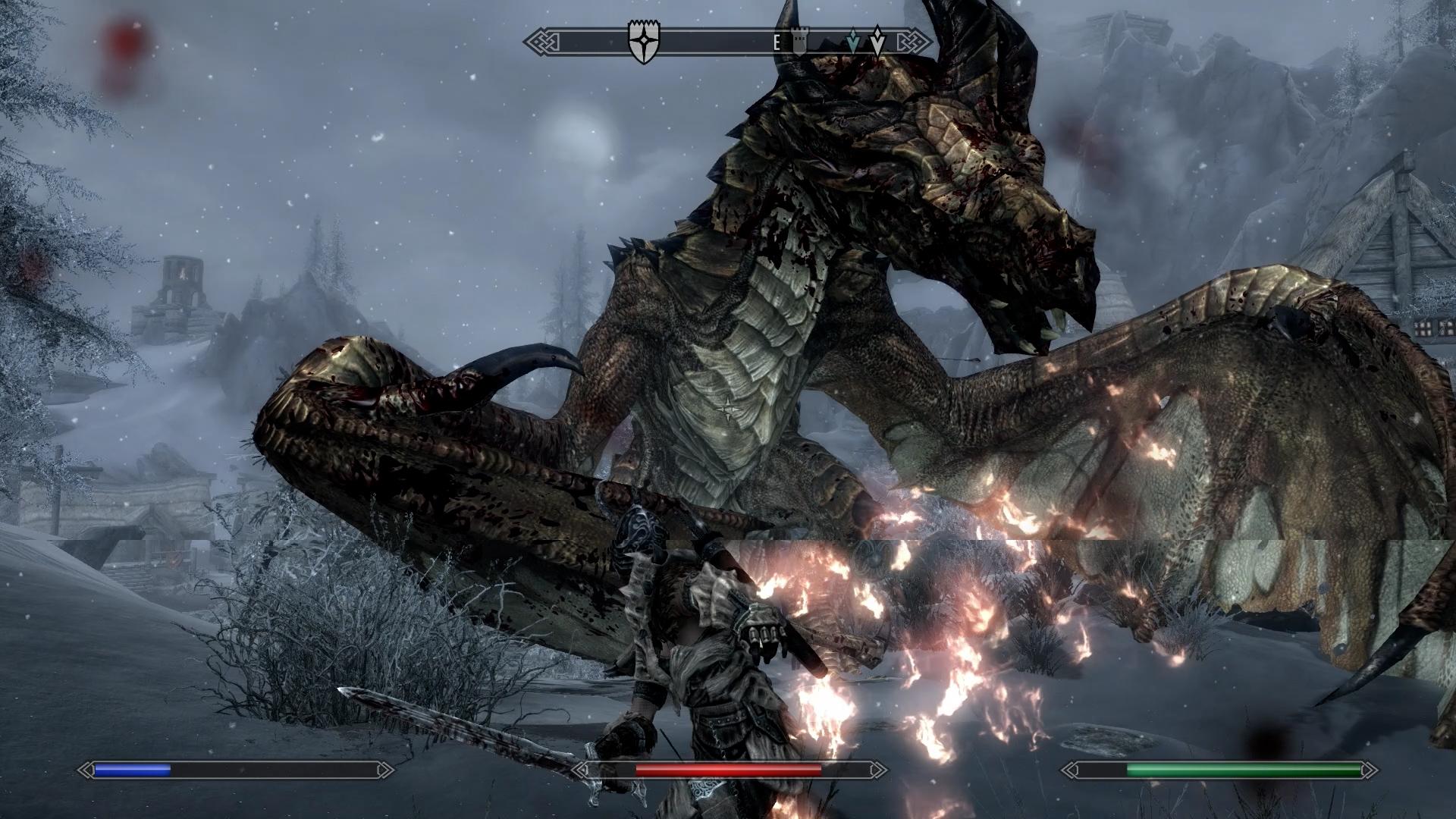
One of Skyrim’s most rewarding side activities is exploration driven by meaningful loot and progression. After a certain point in the main quest, dragons begin to appear, and slaying them lets you absorb their souls to unlock powerful Shouts, which are magical abilities tied to ancient Word Walls hidden throughout the world. Some are tied to quests, others demand pure exploration. Beyond dragons, the game is also packed with rare and unique items for completionists: Daedric artifacts, Dragon Priest masks, skill books, and powerful weapons can all be found in tucked-away dungeons, off-the-path locations or locked behind tough fights. There’s no in-game checklist for all of these, meaning finding them will take some effort and map coverage, so freedom of discovery feels organic.
The game also has a more slow living type of side activity… fishing. Fishing was added later via a free update and lets you catch fish at designated spots using a fishing rod. There are quite a few fish species you can catch, and the fish you catch can be cooked, or used in alchemy or even start some quests through NPCs. This is a more relaxing, low-stakes activity that offers light roleplaying value, but it’s not a core to the experience unless you choose to focus on it.
With Hearthfire, you also get the house-building feature. You can buy land in specific areas and build your own house from the ground up. You start by purchasing a plot from a Jarl’s steward, then use a drafting table and carpenter’s workbench to lay out the structure. You’ll need to gather resources like iron ingots, clay, stone, and lumber, which means either collecting them manually or buying them. As you progress, you can build wings like an armory, greenhouse, or library. It’s more about managing materials and layout choices than freeform design, but it’s a long-term side goal if you want a more personal base of operations.

NPCs in Skyrim sell crafting materials, potions, ingredients, and basic gear. If you’re into smithing or alchemy, checking shops regularly helps with stocking up on hard-to-find items like rare herbs or ingots. However, shops rarely offer powerful weapons or armor unless you’ve invested in Speech or unlocked better vendor inventories. When you’re done bargaining with merchants, you’ll be on the crafting stations, such as the alchemy lab, arcane enchanter, or the blacksmith forge, crafting away new potions or armor. Smithing is a core side activity in the game, as you can craft endgame gear. You can also upgrade the armor through enchanting or refining it with extra materials. If you’re short on supplies or feel like need extra reassurance in battles, you can craft extra potions in the alchemy lab as well.
Overall, Skyrim offers a good amount of side activities with decent depth outside the main questline.
Area of Freedom
Skyrim offers a fully open and continuous world right off the bat, or at least right after the intro. The map is completely unified, so everything from snowy peaks to dense forests is seamlessly connected and explorable on foot, horseback, or via map fast travel once discovered. Carriages in major cities can also take you to other towns early on the same way fast travel does, almost like your local Uber. The fast travel puts you through a loading screen, just like when you enter buildings. Speaking of buildings, every single one of them is accessible one way or another, which is a feat itself. Natural barriers like steep cliffs act as soft limits at the edge of the map, but other than that, the map is like a giant explorable Nordic playground, so you can scale mountains in the middle of the map no matter how steep, almost as if you’re roleplaying a mountain goat instead of the dragonborn.
On that note, freedom is something that Skyrim excels in at all fronts.
Liveliness
Skyrim’s world is visually diverse and atmospheric, with each region carrying its own tone and feel. This is shown by the snow-covered peaks of northern Skyrim to the windswept tundras of the inner regions, the environmental design makes each area feel distinct and natural. The ambient audio also helps reinforce that atmosphere, wolves howl in the distance, and rivers flow through valleys, adding subtle layers that enhance immersion. All that on top of the setting accurate soundtrack that further enhances the medieval fantasy feeling.

Settlements are populated with NPCs that follow believable routines. You'll see guards patrolling, shopkeepers manning their stalls, and townsfolk walking around, occasionally chatting or sitting at inns. Bigger cities like Solitude and Windhelm feel more populated, while smaller villages are understandably quieter. You’ll see a lot of townsfolk walking to bustling markets around the bigger cities; on the other hand, you’ll see fewer NPCs taking it slow, tending to their crops in villages and smaller settlements. The NPCs of skyrim give the settlements a lively atmosphere, even doing as much as reacting to you as they walk past you.
Outside the cities, the number of NPCs you’ll encounter decreases a noticeable amount. Some areas feel well-trafficked with wandering adventurers, hunters, or couriers, but there are long stretches of landscape that can feel a bit empty between random encounters. Campsites and small unmarked locations are scattered around far and few between, with few having NPCs huddling around a fire pit. The world feels rather empty, with a few NPCs showing up here and there outside the settlements. But the wilderness is still filled with wildlife, bandits, and the occasional dragon attack.
Thus, Liveliness is an aspect Skyrim has its perks but is still a partial pass.
Customization
Now let's jump to the customization.
At the start, you can create your character by choosing from ten playable races, each with unique starting abilities and racial bonuses. The character creator allows for adjusting facial features, skin tone, hair, and body type, but once you leave the intro area, you're locked into that appearance unless you find a specific NPC in the thieves guild that allows you to change your face and body. Outside of that, there's no way to change gender, race or name mid-game.

Weapons in Skyrim are straightforward but varied. You can wield one-handed swords, axes, and maces, or go for two-handed variants if you want heavier damage at the cost of speed. Bows are available for ranged combat, and you can dual wield weapons or mix them with magic or shields. Each type of weapon also has a variety of sets to choose from You can also improve base damage at grindstones. Each weapon type has its own swing speed, stamina cost, and damage potential, so you can tailor your loadout based on your playstyle, though animations and move variety are fairly limited.
Did I mention magic? Well, Magic is divided into five categories: Destruction, Restoration, Illusion, Alteration, and Conjuration. Each category contains a variety of spells that can be used in either hand, and you can dual-cast for increased effects if you unlock the right perks. Spell variety covers elemental attacks, buffs, summons, and mind-control abilities. Shouts, on the other hand, are unlocked gradually by discovering Word Walls and absorbing dragon souls. You can equip any unlocked Shout, but you’re limited to one active Shout at a time.

Then comes armor. Armor is split into Light and Heavy types, with distinct perks for each in the skill tree. This means you can tailor your skill tree to match the type of armor you wanna go with. Wanna go for a tank build? or are you more of the mobile stealthy type? There are numerous armor sets in the game, both generic and unique. Each set of armor has a different look. So you can mix and match pieces for visual or gameplay preference.
Also, you can enchant weapons and armor at arcane enchanters using learned enchantments. To unlock new effects, you’ll have to destroy other enchanted gear that you own. Once learned, you can apply those effects to new items using soul gems. Enchantments range from adding elemental damage to weapons, to boosting skill effectiveness or health regeneration on armor.
Then there’s the companion feature, which adds a small customization option. You can recruit various followers throughout the game, each with their own combat preferences and background but it isn’t as easy as looking at their stats, you kind of just realize when you give them items. While you can’t customize their appearance or skills directly, you can equip them with better weapons and armor, which they will use if it improves their stats. That said, their AI sometimes causes them to revert to default gear or behave unpredictably in combat.
Now, House customization is available in a basic form. While you can purchase every home in Skyrim, you can still somewhat choose what rooms to have in your home, like a kitchen, or a greenhouse. Some homes offer display cases, weapon racks, and storage, but most of the furniture and layout is pre-determined. The Hearthfire DLC expands this system by letting you buy land and build your own house from the ground up, adding wings with options like an armory or a trophy room, hiring a steward or a housekeeper of your choice, adopting children, and placing functional items like alchemy labs.
Onto the skill tree, which we won’t count as customization because you can max it out. Skyrim uses a skill-based leveling system. Skills improve as you use them. However, this takes a significant time investment, hundreds of hours of investment to be exact. It adds a slight personalization option to your build at the start, but can all be maxed out in the end.

All that being said, there is a clear abundance of customisation options in Skyrim.
Engagement
Skyrim pulls you into a spiral of side content where even a small distraction can become an hours-long detour. What makes this game engaging isn’t actually the main story, but those countless distractions in between, which can triple or quadruple the number of hours you’ll spend in the main story itself. Everything you do, from looting dungeons to reading books, feeds into your build or sense of place in the world. Skills level up through use, perks shape your identity, and your playstyle naturally evolves through action in the open world. Even crafting or dungeon crawling feel purposeful, with micro-goals that keep you chasing that small improvement, like going from dungeon to dungeon can get you better armor or even materials for the endgame gear.
Now it’s all bread and butter with the side content, but how does this connect to the main story? Well it still brings you back to play the main story, at least for some time, but the game branches off the main story after that. The main story lacks any game changing feature that pushes the player back into the main story.
Essentially, the whole world keeps you engaged more towards the side content partially passing this aspect.
Uniqueness
What's unique about Skyrim isn’t a specific mechanic or story twist, it’s how the game treats you. It doesn’t just hand you a quest to save the world; it drops you into a living, breathing space where you can forge your own legend. You can become a master thief, become an archmage, or just wander from town to town, minding your own business. The game doesn’t punish you for stepping off the path. Instead, it quietly adapts, layering your choices into the world as if they were always part of it.
What makes it even more unique is how the mechanics support that freedom. Whether you're slinging spells, sneaking through dungeons, crafting enchanted gear, or shouting dragons out of the sky, the systems are flexible enough to let you roleplay almost any type of character. You can even become a humble fisherman. You're not locked into a class or playstyle, and your skills grow naturally based on how you play. It’s not about grinding roles, it’s about living them. This freedom almost gives the illusion that the game might be a sandbox, all while incorporating a well thought out narrative around it, which is still difficult to replicate even by today’s open world standards.

Few games give you that much narrative control without forcing it through menus, morality bars, or branching dialogue trees. The game even allows you to add mods to your version of the game, increasing your freedom even more. In that sense, Skyrim’s uniqueness comes from its hands-off approach, it trusts you to decide what kind of story is worth telling.
Ultimately, Skyrim truly gives you a one of a kind experience.
End Verdict
And that wraps up our journey through the mountainous peaks of Skyrim. The Elder Scrolls V: Skyrim Special Edition stands tall as one of the most ambitious open-world RPGs ever made, and even today, it holds up as one of the more iconic titles. It excels in most of the areas that matters in our books, its sheer volume of side content, the sense of freedom it grants players, the depth of its customization features, and a world that is one-of-a-kind. However, as iconic as this game may be, it’s not perfect. The game still has a few aspects where it lacks, which are the feeling of liveliness that dips outside settlements, and engagement that is more side-content-heavy. On the GameTyr scale, The Elder Scrolls V: Skyrim Special Edition earns a solid A Tier, one of the true pillars of the genre.